How to Start a Fuel Delivery Business You Actually Own
The short answer. To start a fuel delivery business, pick the fuels and customers you'll serve, check your state's permit and CDL rules, line up a wholesale fuel supplier, outfit a pickup with small tanks, get insured, and launch your own app and website. With Blink Fuel, the software side costs about $10,000 to $11,000 to start. Most owners launch within months.
Want the money side first? See how a fuel delivery business makes money: one truck, two trucks, three trucks.
Who starts a fuel delivery business?
Two kinds of people call us most.
The first has already had a career. Twenty years as a firefighter, in a trade, or in a corporate job. He retired, got bored, and wants something of his own.
The second is younger. He did well in a shorter career. Now he wants to be his own boss, with nobody looking over his shoulder.
Both want the same thing. A business they own, can grow, and can sell someday.
And the demand is there. Across the U.S., people search Google for "fuel delivery service" somewhere between 1,000 and 10,000 times a month (Google Keyword Planner, Sep 2025 to Aug 2026).
The startup checklist: 8 steps
Print this. Work it top to bottom.
Step 1: Pick your fuels and your customers
Blink handles every fuel: all grades of gasoline, on-road and off-road diesel, heating oil, propane, kerosene, aviation fuel and race fuel.
Then pick who you'll serve. Cars in driveways. Fleet yards. Job sites. Boats. Farms.
Farms are a good example. Many buy propane, off-road diesel and gasoline, and like getting all of it from one supplier on one account. Homes get your truck seen. Fleets, job sites and farms buy the most gallons. Go after both.
Step 2: Check your state's rules, and whether you need a CDL
Many owners start with no CDL. A pickup under 26,001 lbs with small tanks (119 gallons or less each) of diesel can often run without one.
Gasoline is stricter. About 100 gallons of gas stays under the weight that calls for hazmat signs (1,001 pounds of fuel and tanks together, 49 CFR 172.504). Carry more and you'll soon need signs, and signs mean a CDL with a hazmat add-on. Propane bobtail drivers need a CDL with hazmat.
Running a propane bobtail? A loaded bobtail carries more than 792 gallons (3,000 liters) of propane in one tank. That means federal rules require a written DOT hazmat security plan (49 CFR 172.800(b)(3)). Propane Safety Pro writes these plans for propane operations.
Your state, your city and your local fire marshal have their own rules too. Call them and your insurance agent before you buy a truck. This is general information, not legal advice.
Step 3: Line up your fuel supplier
Call the fuel distributors near you. Look for one that does not do on-demand delivery. That way you're their customer, not their rival.
Ask to buy as a volume customer. You get a discount off the posted price and fill up at their rack or bulk plant. Ask two things on day one: what's my price break as my gallons grow, and how do taxes work on fuel I resell? Your accountant should hear that second answer too.
Step 4: Outfit your truck
Most owners start with one truck. A one-ton pickup, 8-foot bed, dual rear wheels if you can. Fuel is heavy. A half-ton can't carry it safely.
Start with one 100-gallon transfer tank, or go to a four-tank skid. Add a fast pump, a hose reel, a filter, a certified meter, a grounding reel, two fire extinguishers and a spill kit. Used skids come up for sale. Look before you buy new.
The full parts list, with rough costs, is on the one-truck, two-truck, three-truck page.
Step 5: Get insured, permitted and sealed
Line these up before your first stop:
- Commercial auto insurance with pollution coverage, plus general liability
- A mobile fueling permit from your local fire marshal, where your area requires one
- Your meter checked and sealed by your state's weights and measures office
- Hazmat safety training for every driver
- Written safety policies your drivers follow. Propane Safety Pro writes safety manuals and can connect you with training partners.
Step 6: Launch your app, office and website
This is the part Blink does. Your website is up in about a week. Your customer app and back office are running a couple of weeks after that.
Your customers order in an app with your name on it. You set your prices, see every order, and send it to a driver in one tap. You watch the truck on a map.
Step 7: Take sign-ups before the truck rolls
Put your website up first. Start taking sign-ups. You'll know your town wants it before you spend on the truck.
Step 8: Run your numbers
You get paid four ways: margin on the gallon, delivery fees, monthly memberships and add-ons. Every one of them is live in the Blink app today.
We built a worked example for one, two and three trucks, plus a calculator. It lists every cost, including driver pay and card fees. It's an example to show how the math works, not a promise of what you'll earn. Put your own numbers in.
Your own business, or a franchise?
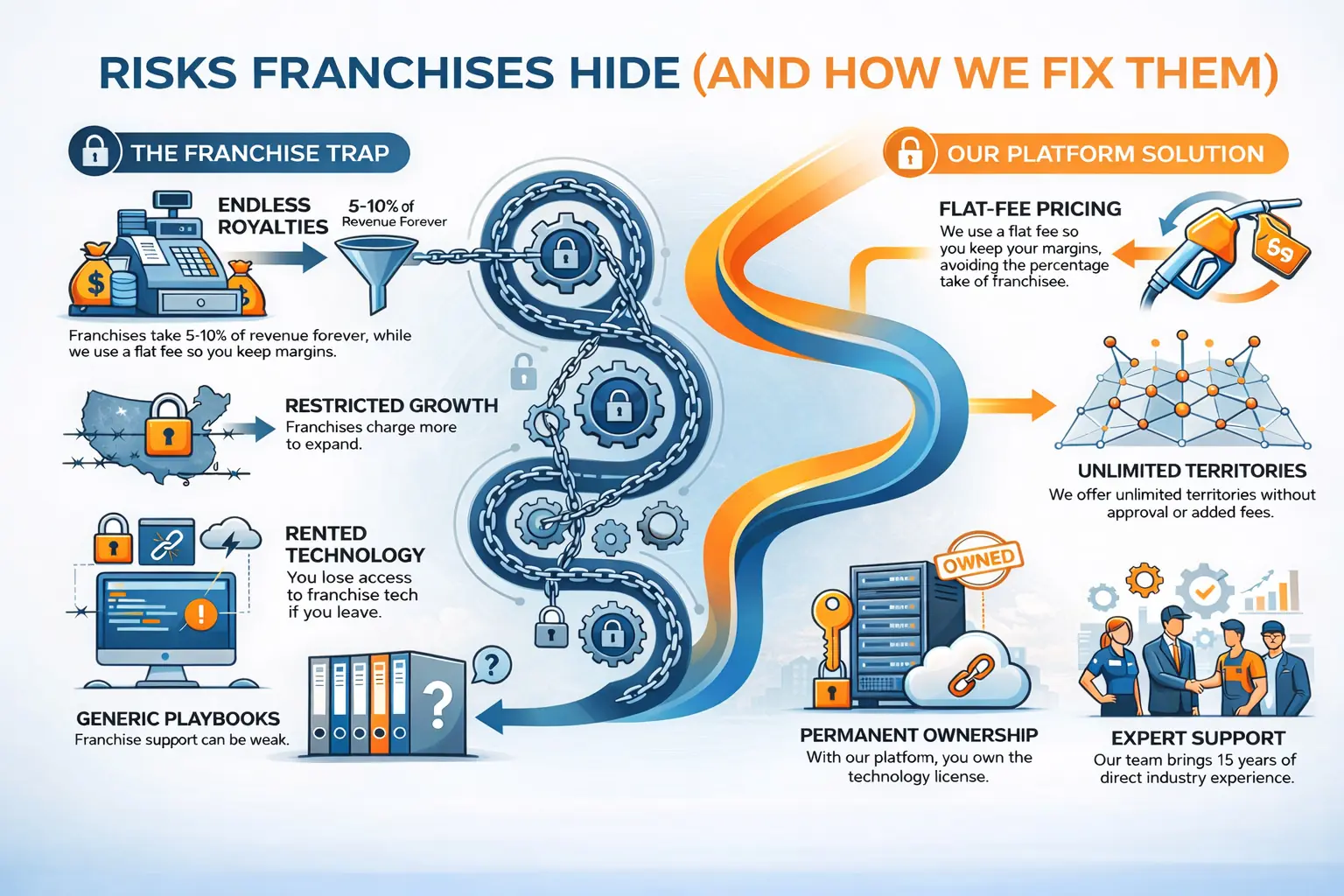
A fuel-delivery franchise costs about $60,000 to $80,000 to start. Blink costs about $10,000 to $11,000. Your truck, tanks and fuel are on top of the Blink number.
A franchise often gives you about a 15-mile circle. Most fuel-delivery companies need about a 40-mile circle to make it. How's that going to turn out? Not well. With Blink there's no territory line.
A franchise takes a cut of your sales every month, even in a losing month. And you can't sell without their OK.
I learned that one myself. My dad and I built a food-delivery franchise. The franchisor took a cut off the top, then a second cut for marketing. When we went to sell, we had to win over two parties: the franchisor first, then the buyer. We weren't building our business. We were building his.
With Blink you own your brand, your customer list and your business. Sell it whenever you want.
More on this: Blink Fuel vs. a franchise, side by side · Blink Fuel vs. building it yourself
Risks franchises hide, and how we fix them
Three owners who did it
We don't use names here. The stories are real.
- The retired firefighter. Twenty years on the job, then he wanted another business. He launched within months with his truck, the software and the website. He was going, and he loved it.
- The excavation company. They wanted a side business that runs itself, so they built a fuel delivery business to grow alongside their excavation work.
- The husband and wife. He's in his 40s with 20 years of experience. They turned it into a new career: on the road, no boss, a business they can build and sell later.
What you get with Blink Fuel
- Your app, your name. Customers order, pick a time, pay, and join a membership. Sell add-ons like wiper blades and tire pressure checks.
- Coupons and push messages that come from you, the fuel guy.
- Your office. Set prices by fuel. Dispatch in one tap. Track the truck.
- The driver app. Stops, routes, meter photos and signatures. It works with no signal.
- Your website. Built for you, up in about a week.
- Safe and backed up. Runs on Amazon's cloud, backed up to a second server in another region.
- Card processing that costs less. It could save you hundreds a month, which over time could go a long way toward paying for the software.
The pieces inside Blink are products we also sell on their own: the Custom Fuel App your customers order from, the Tank Spotter driver app, and a FuelSite.pro website. Blink gives you all three.
Starting in propane? Read what it takes to start a propane business on Propane Insider.
Who built it
Bill Stomp: 25-year propane operator who grew from one location to 87 branch offices across 12 states, combat veteran, and has helped 200+ propane companies since.
He's spent 16 years building this software, with engineers on two shifts a day. It has been field-tested for over a decade by well over 100 fuel companies and thousands of drivers, managers and owners. We've fixed more problems than newer systems have run into yet. The driver handheld won the Virtual Propane Expo Technology Competition and the World LP Gas Technology Competition.
Questions people ask
How much does it cost to start a fuel delivery business?
With Blink Fuel, the app, office and website cost $11,000 to set up, then $1,100 a month. Your truck, tanks, insurance and first fuel are extra. A one-ton pickup runs about $45,000 to $70,000 new or used, and it can be financed. A fuel-delivery franchise costs about $60,000 to $80,000 to start.
Do I need a CDL to deliver fuel?
Often not at first. A pickup under 26,001 lbs with small diesel tanks (119 gallons or less each) can often run without one. About 100 gallons of gasoline stays under the weight that calls for hazmat signs. Carry more and you'll soon need signs, and signs mean a CDL with hazmat. Propane bobtails need one too. Your state decides, so check before you buy.
What fuels can I deliver?
With Blink, any fuel: all grades of gasoline, on-road and off-road diesel, heating oil, propane, kerosene, aviation fuel and race fuel. Start with one and add more as your customers ask.
Should I buy a fuel delivery franchise or start my own?
A franchise costs about $60,000 to $80,000, often limits you to about a 15-mile circle, takes a cut of your sales every month, and needs its OK before you sell. Your own business with Blink costs about $10,000 to $11,000, has no territory line and no cut of sales, and you can sell it whenever you want.
How fast can I launch?
Your website is up in about a week. Your customer app and back office run a couple of weeks after that. Most owners launch within months, once the truck, permits and insurance are in place.
Where do I buy fuel wholesale?
From a local fuel distributor. Pick one that doesn't do on-demand delivery, so you're a customer, not a rival. Ask to buy as a volume customer. You get a discount off the posted price and fill up at their rack or bulk plant.
Is a fuel delivery business profitable?
It depends on your margin per gallon, fills a day, fees and costs. Our one-truck, two-truck, three-truck page walks through a worked example with every cost shown, and a calculator for your own numbers. It's an example, not a promise. You could earn less or lose money.
Can I finance a fuel delivery business?
We have access to 100% financing for the Blink software, subject to credit approval. Trucks and skids can be financed through your own lender. Ask about it on your demo. See financing options.
What does the customer app do?
Your customers order fuel, pick a time and pay. They can join a monthly membership to stay topped off, and buy add-ons like wiper blades and tire checks. You send them coupons and push messages. You see every order and track your truck.
Next steps
- Print the checklist above. Work steps 1 to 5 this week.
- Run your numbers on the one-truck, two-truck, three-truck page.
- Book a demo. We'll show you the app in your brand and walk through your numbers with you.
You can own this business for about $10,000 to start. Book a demo.
Sign up for a demo now
We'll show you the app in your brand and walk through your numbers with you.
Examples on this page and the linked math page are not a promise, forecast or typical result, and are not the results of any Blink Fuel customer. You could earn less or lose money. Rules on licenses, permits, CDLs and equipment vary by state and city; this page is general information, not legal, tax or insurance advice. Financing is subject to credit approval. Blink Fuel is software. It is not a franchise and does not sell territories. Blink Fuel is made by the same company that makes Custom Fuel App, Tank Spotter, FuelSite.pro and Propane Safety Pro, and publishes Propane Insider.